

Do You Have The Missing Piece of Business Reputation?
Businesses invest enormous amounts of time, energy, and resources building their reputations. They work to deliver exceptional customer experiences, earn positive reviews, strengthen their brands, and establish themselves as trusted organizations within the communities they serve. Over time, these efforts shape how customers, employees, business partners, and the public perceive an organization. A strong reputation is rarely built through a single interaction. It is earned through consistent actions that demonstrate reliability, integrity, and trust.
Over the past two decades, businesses have developed increasingly sophisticated ways to build and communicate that trust. Online reviews help demonstrate customer satisfaction. Professional certifications validate expertise and competence. Industry awards recognize excellence, while thought leadership reinforces credibility and authority within a particular field. Together, these signals provide a more complete picture of a business and help customers make more informed decisions about who they choose to do business with.
Yet despite all of these advancements, one meaningful part of business reputation has remained largely overlooked.
For generations, businesses have invested in their communities through charitable giving, nonprofit partnerships, sponsorships, volunteer initiatives, scholarships, and countless other forms of civic engagement. These efforts often reflect an organization's values just as clearly as the products it sells or the services it provides. They influence how people perceive a business, but they have never become a lasting part of the business's overall reputation. Instead, they remain scattered across dozens of websites, social media platforms, press releases, event pages, and local news stories, making them difficult to preserve, difficult to discover, and even more difficult to understand as a complete picture.
Verified Community Impact exists to address that missing piece.
Reputation Has Always Been Bigger Than Reviews
When most people think about business reputation today, they naturally think about customer reviews. That association makes sense. Reviews have become one of the most visible and influential trust signals available to consumers. They help answer an important question before someone decides to do business with an organization: What has the experience been like for other customers?
Reviews, however, tell only one part of a much larger story.
Customers increasingly evaluate businesses through a broader lens. They pay attention to company values, community involvement, environmental responsibility, employee culture, and the ways organizations contribute to the communities where they operate. These considerations often shape purchasing decisions long before a customer ever reads a review or requests a quote. They provide context that helps people understand not only how a business performs, but what kind of organization it chooses to be.
This broader perspective has quietly expanded the meaning of business reputation. Trust is no longer based exclusively on customer experiences. It is increasingly influenced by the character a business demonstrates through its actions beyond the transaction itself.
The Problem With Community Recognition
Although businesses receive recognition for many of their community contributions, that recognition has traditionally been temporary by design.
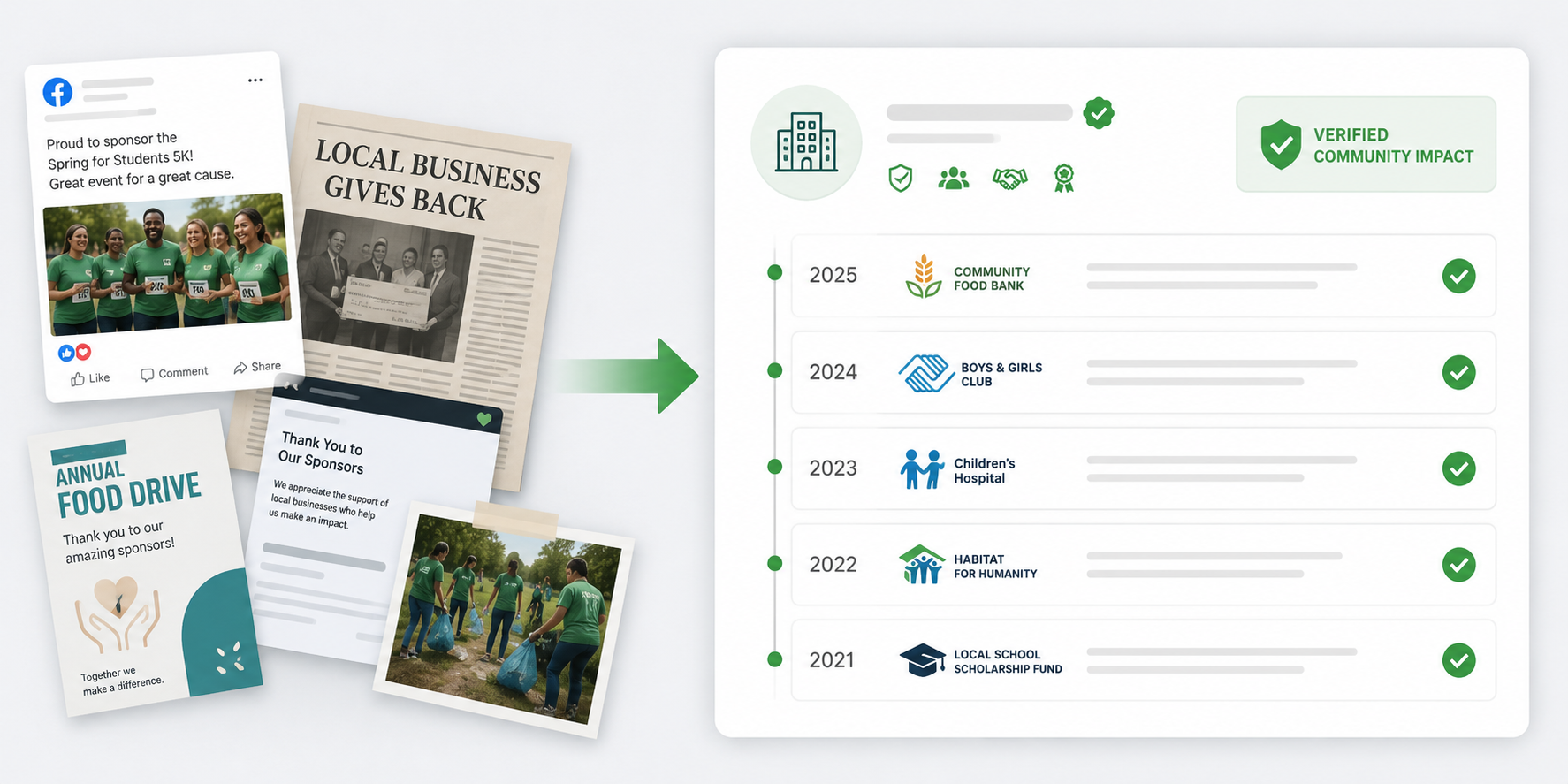
A nonprofit may thank its sponsors on an event webpage. A local newspaper may publish a story about a charitable donation. Volunteer photographs are shared across social media, while organizations issue press releases celebrating fundraising campaigns or community partnerships. Each piece of recognition serves an immediate purpose, acknowledging the contribution and expressing appreciation for the support received.
What these forms of recognition were never designed to do is preserve a business's long-term reputation.
As time passes, event pages are replaced, websites are redesigned, social media posts become buried beneath thousands of newer updates, and news coverage fades from public attention. While each contribution remains meaningful, the evidence becomes increasingly fragmented. Businesses accumulate years of community involvement, yet much of the story exists only as isolated moments scattered across the internet.
Introducing Verified Community Impact
Verified Community Impact provides a framework for preserving that history.
Rather than treating every sponsorship, volunteer initiative, nonprofit partnership, or charitable contribution as an independent event, Verified Community Impact recognizes that these activities collectively represent an important part of a business's reputation. When they are documented consistently, supported by credible evidence, and organized within a structured framework, they begin telling a much larger story than any individual contribution could communicate on its own.
This distinction is fundamental.
Community involvement describes what a business does.
Verified Community Impact describes what a business earns when those actions become part of a credible, organized, and enduring record of community leadership.
Just as customer reviews transformed individual customer experiences into an ongoing measure of service quality, Verified Community Impact transforms individual acts of community involvement into a lasting measure of community trust.
It does not replace community involvement. It preserves its value.
Why Verification Matters
Every reputation is ultimately built on evidence.
Businesses have always communicated their values through websites, advertising, annual reports, and public relations efforts. While these communications are important, they primarily reflect what organizations say about themselves. Increasingly, customers place greater confidence in information that can be supported through independent sources and demonstrated through consistent actions over time.
Verification strengthens credibility because it shifts the conversation from claims to evidence.
When community contributions are connected to the organizations involved, documented with meaningful context, and supported by verifiable information, they become significantly more trustworthy than isolated marketing statements. Instead of simply telling customers a business cares about its community, verification allows businesses to demonstrate that commitment through a record of documented actions.
This distinction is becoming increasingly important as trust continues to evolve. Across nearly every industry, credibility is moving away from self-description and toward independently supported evidence. Community involvement is no exception.
Why Structure Matters
Verification alone, however, is only part of the solution.
Information that exists across dozens of nonprofit websites, event pages, news articles, and social media platforms remains difficult to interpret, even when every source is accurate. Individual pieces of evidence rarely communicate the broader pattern of community involvement that develops over many years.
Structure provides that missing context.
When community contributions are organized within a consistent framework, they become more than isolated acts of generosity. They reveal continuity. Customers begin to see not only that a business sponsored one local event, but that it has consistently invested in education, healthcare, youth development, neighborhood organizations, and charitable causes throughout its history.
What once appeared as disconnected moments begins to reflect an enduring commitment to the community.
This principle is not unique to community involvement. Financial reporting became more valuable when standardized statements created a complete picture of organizational performance. Customer reviews became more meaningful when thousands of individual experiences could be understood collectively. Organizing information creates understanding that isolated pieces of evidence cannot provide on their own.
Community reputation deserves the same opportunity.
Why This Matters in an AI-Driven World
The importance of structured information extends well beyond human readers.
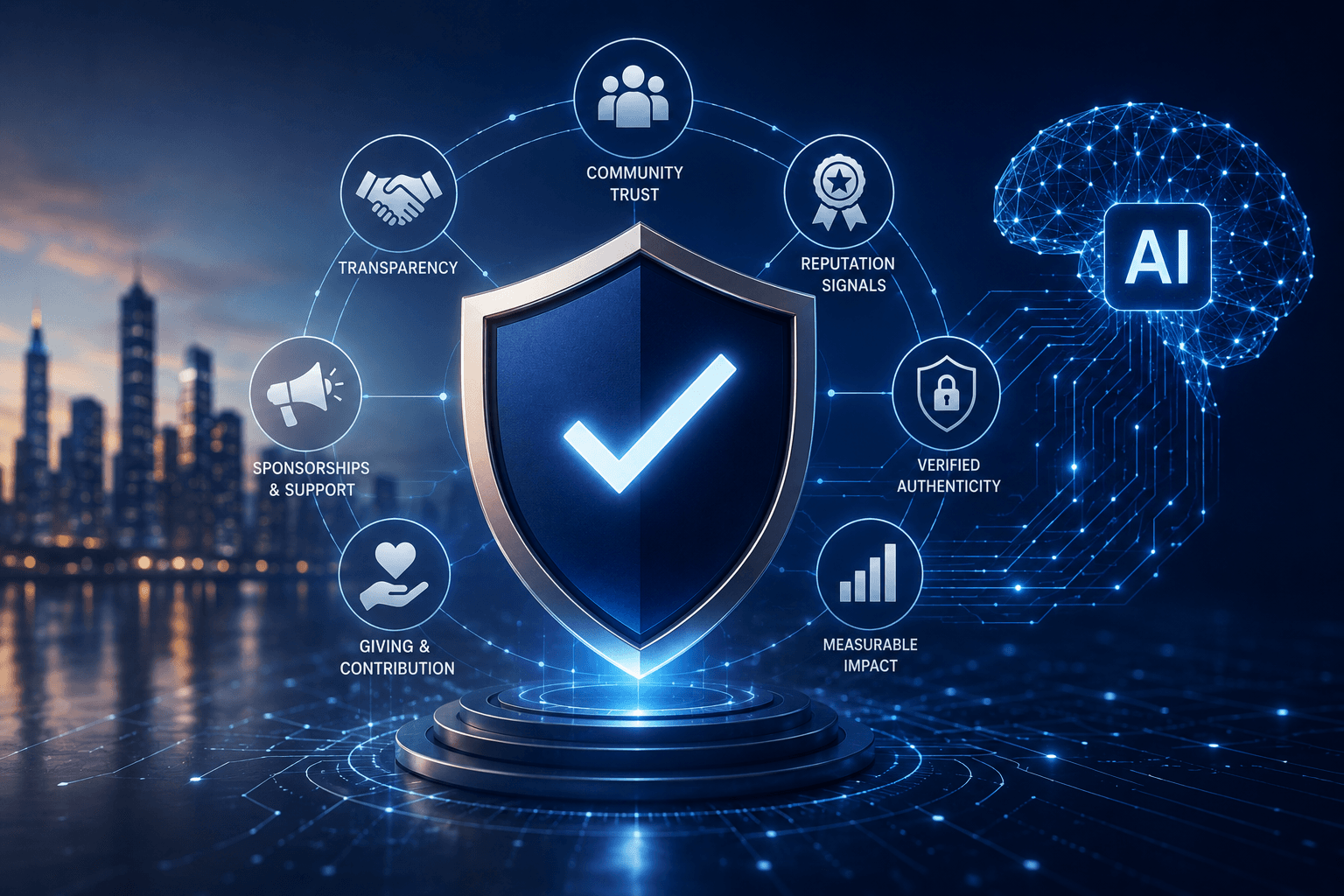
Search engines and artificial intelligence increasingly rely on organized, credible, and well-supported information to understand businesses and answer questions about them. These technologies are remarkably effective at interpreting structured information, but far less capable of connecting fragmented evidence spread across hundreds of unrelated websites.
As AI becomes an increasingly common way for people to research businesses, compare providers, and make purchasing decisions, organizations will benefit from presenting community involvement in ways that are clear, organized, and supported by trustworthy evidence. Businesses that document their contributions effectively will be easier for both people and intelligent systems to understand than those whose community involvement exists only through scattered digital recognition.
The future of business reputation will depend not only on what organizations do, but on how effectively those actions can be demonstrated.
Completing the Picture of Business Reputation
Customer reviews answer an essential question: How does this business treat its customers?
Verified Community Impact answers another question that has become increasingly important: How does this business contribute to the community it serves?
Neither replaces the other.
Together, they create a more complete understanding of trust.
One reflects the experiences customers have after doing business with an organization. The other reflects the values and commitments that often shape perceptions long before a customer ever becomes a customer. Businesses have always understood that both matter. What has been missing is a way to preserve and communicate that second dimension with the same clarity and credibility that reviews brought to customer experience.
That is the role Verified Community Impact is designed to fulfill.
Looking Ahead
Business reputation has never been static. As expectations evolve, organizations continually discover new ways to demonstrate trust, credibility, and long-term value. Reviews changed how businesses communicate customer satisfaction. Certifications established recognized standards of expertise. Digital reputation expanded how organizations are discovered and evaluated online.
Verified Community Impact represents the next step in that evolution.
Businesses have always invested in their communities. What has been missing is a consistent way to preserve those investments as part of the reputation they build over time. As customers, partners, search engines, and AI systems increasingly rely on structured and trustworthy information to understand organizations, documenting community involvement will become just as important as doing the work itself.
The businesses that recognize this shift early will not simply be known for the good they do. They will be remembered for it.
Ready to Begin Building Your Verified Community Impact?
If your business supports nonprofits, sponsors community organizations, or invests in local causes, you may already have the foundation of a Verified Community Impact.
Create your free profile to document your community involvement, organize it into a structured and trusted record, and preserve the reputation you've earned through the communities you serve.



 support@mastergiver.com


